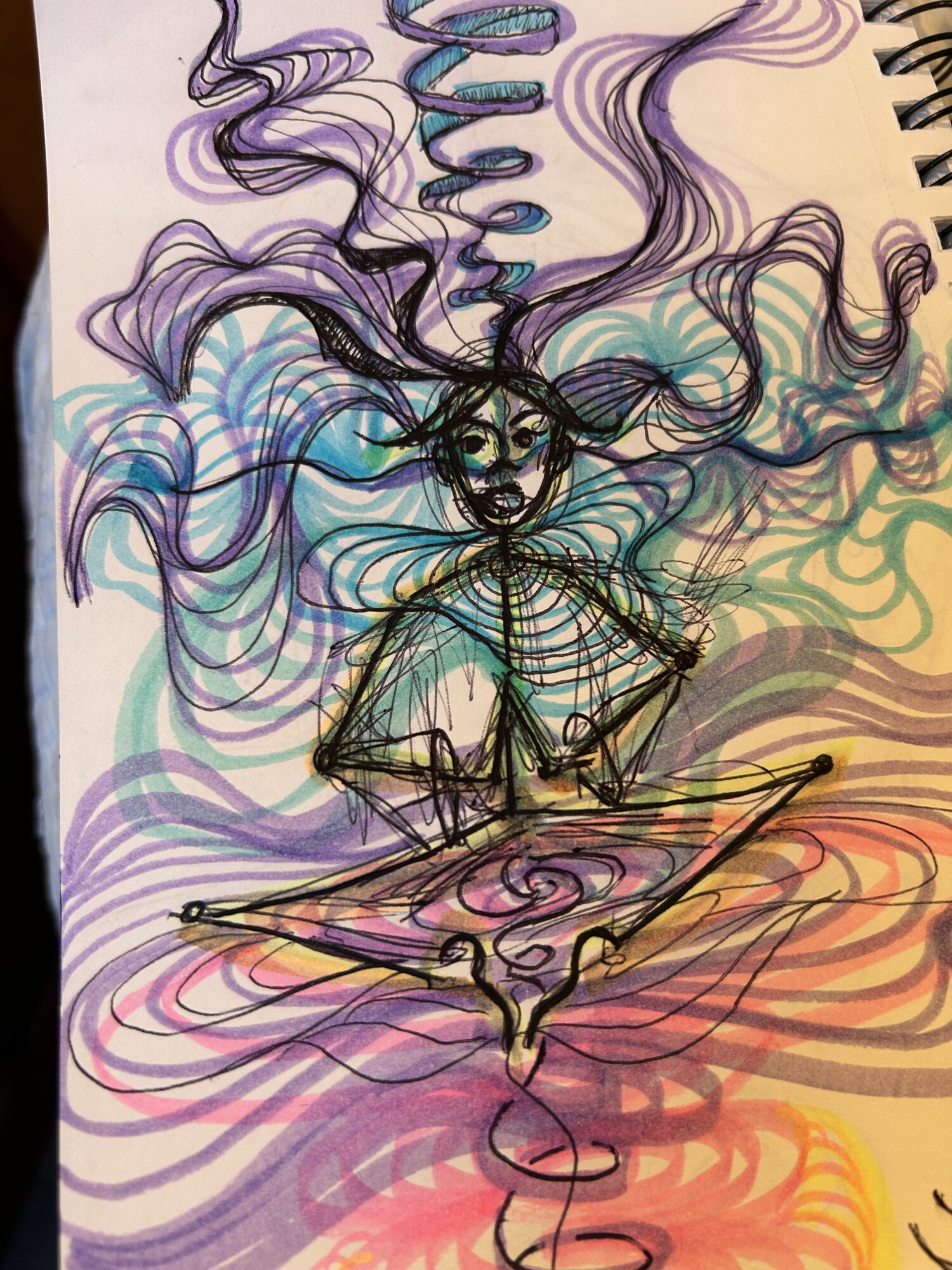
I do not always sketch before I draw.
This is not a stylistic choice in the aesthetic sense. It is a practical one based on what I have learned about how the most alive work actually arrives.
When I come to the drawing table with a plan, sometimes something closes. The creative instinct, which has its own agenda and its own intelligence, steps aside to let the plan run. And the plan, however good it looks on paper, is working from a smaller place than the thing it is replacing.
Automatic drawing is what happens when you do not bring a plan.
What Automatic Drawing Actually Is
Automatic drawing has roots in surrealism. The surrealists were interested in accessing the subconscious directly, bypassing the editing mind to let something more raw and more true come through. They called it automatism.
But the practice is much older than that. In spiritual traditions across cultures, the idea of the hand being guided by something other than the conscious will, by a spirit, a higher self, or simply the deeper subconscious, has been present for a very long time.
What I do is somewhere between those two things.
I sit in meditation. Something comes up. An image, a feeling, a quality of energy that wants to be expressed. And then I go directly to the drawing table and make the first mark without deciding what it will be.
From there I follow. The line goes somewhere. I follow it. Something emerges that I did not plan. I keep following until the piece is complete or until I feel the energy shift and the session is done.
This is not magic and it is not mystical in a way that requires any particular belief system to access. It is simply the practice of getting the editing mind out of the way and letting a different faculty take the wheel.
How I Get Into the State
The state that makes automatic drawing possible is not something I can force. But it is something I can create conditions for.
Meditation is the most reliable entry point.
Deep trance meditation especially. When I sink below the surface level of ordinary thinking into the quieter place underneath it, something opens. Images become more vivid. The inner knowing gets louder. The distance between what I sense and what I am willing to put on the page gets smaller.
The window right after meditation is when I am most available for automatic drawing. The fifteen minutes after I come out of a trance state, before I look at my phone, talk to anyone, or re-engage the planning mind. That window closes quickly. I try to use it.
Movement helps before that. Somatic practices, shaking, and dancing that get the body out of its usual patterns and into something more fluid. Theta wave frequencies on Spotify or YouTube, which carry the brain toward that specific threshold between conscious and subconscious where the imagery gets more vivid and the inner critic quiets down.
Sound healing has become part of this preparation too. Sending energy through the sacral chakra before I draw is a consistent part of the practice.
The Pieces That Came From This
The tornado spiral piece, the one I think of as the quantum field drawing, arrived in one of these sessions.
I sat down with no plan. Made the first mark, a single curving line, and followed it. The tornado shape emerged. The parallel timelines branching off and coming back. The darkest place at the center where things converge. None of that was designed. It was discovered.
The collective timeline piece happened the same way. I sat down thinking I might draw something with color. The structure of souls traveling together on their paths, the colors meeting at the darkest central point, and the branching lines of individual parallel timelines emerged through the following rather than through any intention I brought to the table.
The marble painting is another one. I was working on a piece about a soul moving through space and time, and partway through, marbles started appearing in the imagery. Unplanned. Uninvited. But immediately recognizable as significant, given what the marble story had meant to me in the months before.
The automatic process revealed something the conscious process would never have thought to include.
What the Resistance Feels Like
I want to be honest that this is not always easy.
There is a version of sitting down at the drawing table that wants to know what is going to happen. That finds the open-endedness uncomfortable rather than exciting. That would rather have a plan because a plan provides something to execute and execution is familiar.
That is the editing mind wanting to be in charge.
The practice of automatic drawing is partly a practice of tolerating the discomfort of not knowing. Of making the first mark without knowing where it will go. Of following a line that has not yet decided where it wants to end up.
Over time that discomfort has become interesting rather than threatening. The not-knowing is where the discovery lives. And the discovery, reliably, is better than whatever I would have planned.
On What Comes Through
Automatic writing works the same way for me.
I sit down with no plan. I begin and genuinely do not know what is going to come out. Things arrive that surprise me. Quotes that feel like they arrived rather than were written. Insights I had not consciously assembled. Analogies that are more precise than anything I would have constructed deliberately.
The information flows from somewhere that is not my ordinary thinking mind.
Whether that is the subconscious, the higher self, something coming through from a larger source, or simply the intelligence of the body finding its way onto the page, I hold with genuine uncertainty.
What I do not hold with uncertainty is that it works. That the following produces something the planning cannot.
Automatic drawing is an act of trust. Trust that something worthwhile is there. Trust that it will come through if you get out of the way. Trust that the hand knows things the mind has not figured out yet.
Start with one mark. Follow it. See what is there.